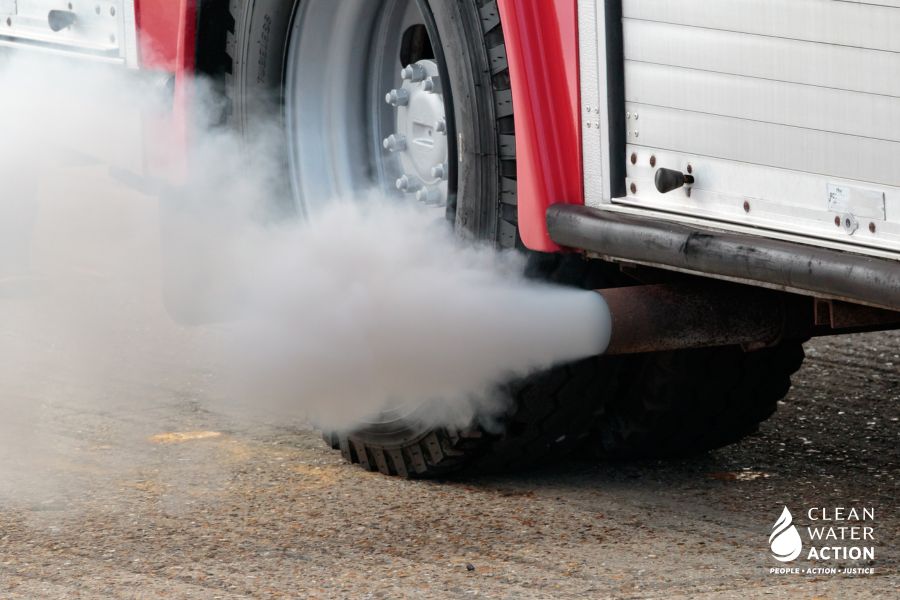
Truck count in Elizabeth highlights local ordinance violation---advocates call for support for stronger policy to diesel truck pollution in NJ
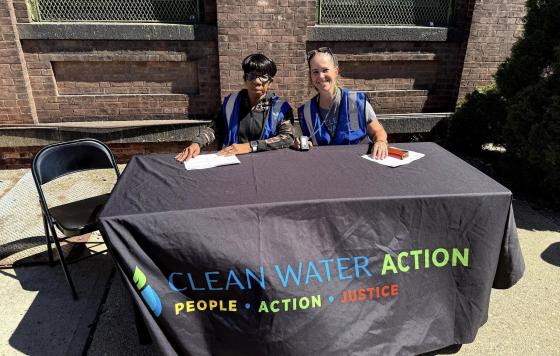
[Elizabeth, NJ] [August 27, 2025] - Today, Clean Water Action and local Elizabeth residents concluded the summer with another truck count and air monitoring session.
This truck count was organized by Tolani Taylor, Zero Emissions & Warehouse Organizer for Clean Water Action. Together, both Clean Water Action staff and Elizabeth residents counted over 80 diesel-fueled trucks in just 1 hour along the intersections of First Street and South Street and First Street and Trumbull Street in Elizabeth, NJ. Atmotube air monitor sensors were used to capture the concentration of P.M 2.5 (Particulate Matter), a common air pollutant emitted from diesel trucks.
Doing this truck count and documenting the data comes at a critical time--the diesel trucks that are prohibited from traveling on First Street due to a current local ordinance known as No.4809, are starting to come back. Data from previous years shown in the images attached also indicate an increasing volume of trucks on First Street, as well.
This calls into question whether overburdened communities, like Elizabeth, can truly rely on local policies like ordinance No. 4809. State-wide policy, like an Indirect Source Review (ISR) Program, would be a more effective and sustainable solution when it comes to reducing diesel truck pollution at NJ’s ports and warehouses. Luckily, a bill in the NJ Legislature, the NJ ISR Bill (Indirect Source Review), A4679/S3545, currently exists and is focused on providing both immediate relief to communities most impacted while giving industry players flexible means of reducing their air emissions in their daily business operations.
Clean Water Action and other members of the Coalition of Healthy Ports, have been advocating for the NJ ISR Bill (A4679/S3545) since last June 2024, when NJ lawmakers officially introduced it in the legislature. That same month, the Environmental Defense Fund (EDF) released the NJ Warehouse Proximity Report, highlighting how the growing number of warehouses near homes and schools is putting communities at greater risk from diesel truck pollution.
How passing the NJ ISR Bill A4679/S3545 benefits all, from port to warehouse, to delivery:
- Improves air quality and health, especially for NJ’s overburdened communities
- Reduces chronic exposure to air pollutants for freight and goods movement workers
- Generates cost-savings (e.g. lower fuel costs) for trucking companies who commit to transitioning to zero-emission infrastructure
Since the NJ ISR Bill was introduced, truck traffic and pollution have increased, warehouse development keeps getting approved and climate change disasters directly linked to increased air pollution from the transportation sector have only intensified here in NJ.
Hopefully, the recent progress regarding ISR’s for example, other states such as California, Illinois and New York are introducing their own versions of ISR policy and the recent addition of charging stations at Port of Newark, can encourage legislators from the local and state levels to tackle diesel pollution in NJ’s goods movement industry with the passing of A4679/S3545.
“I heard several complaints from community members leading up to the truck count and advocates on concerns that the trucks are coming back along First Street, despite the local ordinance that is supposed to provide them with some relief. Collecting this ongoing truck pollution data on First Street not only highlights the violation of a city ordinance, but also outlines the urgency to have state-wide policy like the NJ ISR Bill to provide necessary relief in the form of better air quality for overburdened communities.” - Tolani Taylor, Zero Emissions & Warehouse Organizer at Clean Water Action.
“Passage of the NJ ISR Bill is paramount. The results of the truck count prove that this legislation is necessary for Elizabeth, a near-port community, and others, like Newark. We cannot keep sacrificing the health of our communities for the “convenience” of goods movement.” - Alejandra Torres, Assistant Director of Advocacy and Organizing at Ironbound Community Corporation.
"It was exciting to be part of Tolani Taylor's Truck Count. The residents of Elizabeth deserve to have equal rights to clean air and this was one step toward ensuring that happens." - Marta Young, Zero Waste Specialist with Clean Water Action.
###
Clean Water Action is a national 501(c)(4) environmental organization with nearly one million members nationwide. Since our founding during the campaign to pass the landmark Clean Water Act in 1972, Clean Water Action has worked to win strong health and environmental protections by bringing issue expertise, solution-oriented thinking and people power to the table. Learn more at cleanwater.org.
The Coalition for Healthy Ports (CHP) is a broad-based coalition of environmental justice, labor, faith, community, and environmental organizations in N/YNJ working to improve the air quality and health of communities and workers, as well as to ensure that environmental justice is achieved in affected communities. Clean Water Action is the founder of CHP.