Trenton, NJ – A federal court settlement worth more than $2 billion, the largest environmental settlement ever reached by a single state, is set to fund the cleanup of widespread PFAS contamination at four former DuPont industrial sites across New Jersey, state officials announced Monday.
PFAS (per-and poly-flouroalkyl substances) are a class of human-made chemicals that are toxic even in very low concentrations. Because they are stain and oil resistant and repel water, PFAS have been widely used since the 1950s in many common consumer products, including carpets, clothing, cookware, cosmetics, and food packaging. These “forever chemicals” are highly persistent and mobile in the environment, which means they bioaccumulate and travel unchanged through streams, rivers, and other water bodies, including drinking water sources. PFAS are linked to serious health problems including damage to liver, thyroid, and pancreatic function, immune system harm, hormone disruption, high cholesterol, and cancer.
“The ruling is obviously a significant victory and excellent start that should provide an example of perseverance for the other 49 states and a wake-up call to major corporations doing business involving PFAS,” said Colron Chambers, NJ Board Co-Chair, Clean Water Action.
“Clean Water Action is making sure policymakers hear that wake-up call and start acting on PFAS pollution where it starts. If we keep manufacturing and using PFAS chemicals, they will lead to the need for more drinking water treatment and thus higher costs for communities and our water bills,” said Jeff Carter, President & CEO, Clean Water Action.
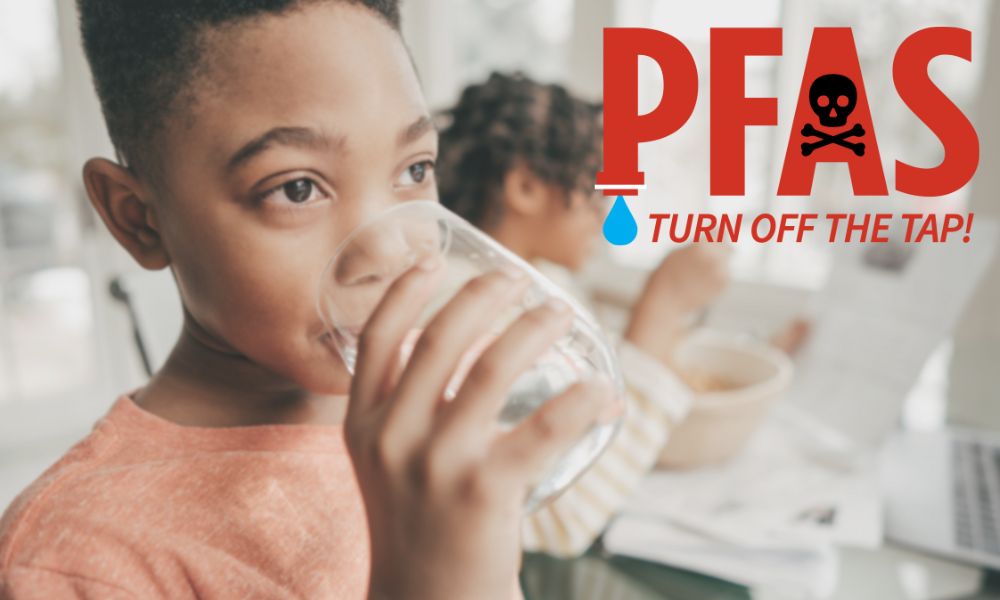
Clean Water Action has long led state and national efforts to hold PFAS producers accountable for their wrongdoing. But just as importantly we are leading the way when it comes to turning off the PFAS tap – banning it from products in the future. Just as NJ established the strictest PFAS standard for drinking water, we are now on pace to eliminate PFAS where consumer and worker exposure is particularly concerning,” said Molly Cleary, NJ Environmental Advocate, Clean Water Action.
As the federal government steps back from protecting people, communities, water supplies and environment from the dangers of PFAS, states must step up to do it as NJ has in the past with drinking water standards and proposes to do in the future.
Below are three NJ bills that are advancing in Trenton. There is unprecedented and widespread bipartisan support for banning PFAS. Clean Water Action’s goal is to move this package of legislation through the State Senate and onto the Governor’s desk as soon as they come back from into session.
S3946 - Banning PFAS in firefighting turnout gear
- Passed Assembly floor vote 70-6
- Awaiting Senate Floor vote
S3669 - Limiting/banning PFAS in menstrual products
- Passed Assembly floor 78-0
- Awaiting Senate Commerce Committee and Floor vote
A5260 - Banning PFAS in apparel
- Passed the Assembly floor 55-19
- Awaiting Senate committee action and Floor vote
S1042 - Banning PFAS in consumer products ( similar to Minnesota’s “Amara’s Law”)
- Heard for “discussion only” in the Senate Environment Committee
- Awaiting Committee action
“The stakes are too high and dangers too great, cost too expensive to think that cleaning up 'forever chemicals; is the only path worth taking forever. The best solution to stop creating and using these chemicals forever more. Clean Water Action’s package of NJ bills does just that,” concluded Amy Goldsmith, NJ State Director.
Background on the announcement:
EPA has finalized enforceable Safe Drinking Water Act (SDWA) limits (known as Maximum Contaminant Limits or MCLs) for two of the oldest PFAS chemicals - PFOA and PFOS - at 4 parts per trillion (ppt), the lowest level that can be reliably measured in drinking water. EPA has also responded to the call from impacted communities and advocates to address the many other PFAS chemicals being found in water around the country by finalizing enforceable limits for three other PFAS chemicals - PFHxS, HFPO-DA (GenX chemicals), and PFNA. Because research indicates that PFAS chemicals can cause health risks at lower levels and in mixtures, EPA has also finalized a hazard index approach to regulating four chemicals - PFHxS, HFPO-DA (GenX chemicals), PFNA, and PFBS - when they occur in mixtures. The EPA has since delayed enforcement of these limits.
##
Clean Water Action is a national 501(c)(4) environmental organization with nearly one million members nationwide. Since our founding during the campaign to pass the landmark Clean Water Act in 1972, Clean Water Action has worked to win strong health and environmental protections by bringing issue expertise, solution-oriented thinking and people power to the table. Learn more at cleanwater.org.