Michigan Board of State Canvassers approves petition summary; coalition preparing to launch statewide signature drive
LANSING, MI —By a 4 to 0 vote, the Michigan Board of Canvassers has approved the summary and form of a petition to restrict certain corporate donations in state politics and prevent conflicts of interest between politicians and state contract holders.
The ballot initiative sponsored by the Michiganders for Money out of Politics (MMOP) coalition aims to prohibit regulated utility monopolies and companies that have or are seeking contracts above $250,000 with the State of Michigan from making donations to political campaigns for the office holders who regulate them. The ballot initiative would also close the biggest dark money loophole in Michigan election law by requiring disclosures for campaign ads put out leading up to an election.
15 states including Connecticut, Hawaii, and Georgia and the Securities Exchange Commission have passed similar prohibitions on political spending. If passed by the voters, Michigan’s law would combine the best aspects of multiple laws to create the strongest law in the country.
“When powerful corporations spend big to influence elected officials, the people of Michigan lose our voice in our own government,” said Sean McBrearty of Clean Water Action. “There is a conflict of interest when regulated utilities and big government contractors are financially supporting the elected officials who should be working for the people they represent. Our democracy should not be for sale, and we are ready to take this to the voters.”
“This has been a long time coming. Our people can’t wait to get started,” said James Johnson, Jr. of Detroit Action. “We had hoped the legislature would do the right thing on their own but it looks like if the people want to get money out of politics, we’re going to have to do it ourselves.”
Utility giants DTE Energy and Consumers Energy would be the two regulated monopolies most affected by the proposal, and large state contract holders like Blue Cross Blue Shield of Michigan and AT&T will also fall under the new restrictions. These corporations are among the largest donors to state political campaigns, and their political donations present a clear conflict of interest to elected officials.
With the summary and form approval secured, the coalition will now begin the work of gathering over 356,958 signatures in 180 days in order to get the proposal on the ballot in 2026. MMOP is already in the process of training hundreds of volunteers to circulate the petition across the state, and have more recruitment town halls coming up across the state and online in the coming days and weeks.
“Getting corporate money out of Michigan politics is a wildly popular idea,” said Christy McGillivray of Voters Not Politicians. “From voters who want to drain the swamp to voters who want to defend civil rights, voters across the political spectrum all agree: Our democracy should never be for sale. Now is the opportunity for every Michigander to come together to help make politicians work for us instead of their donors. Visit MopUpMichigan.org to find out how you can become part of this historic movement.”
###
About Michiganders for Money Out of Politics
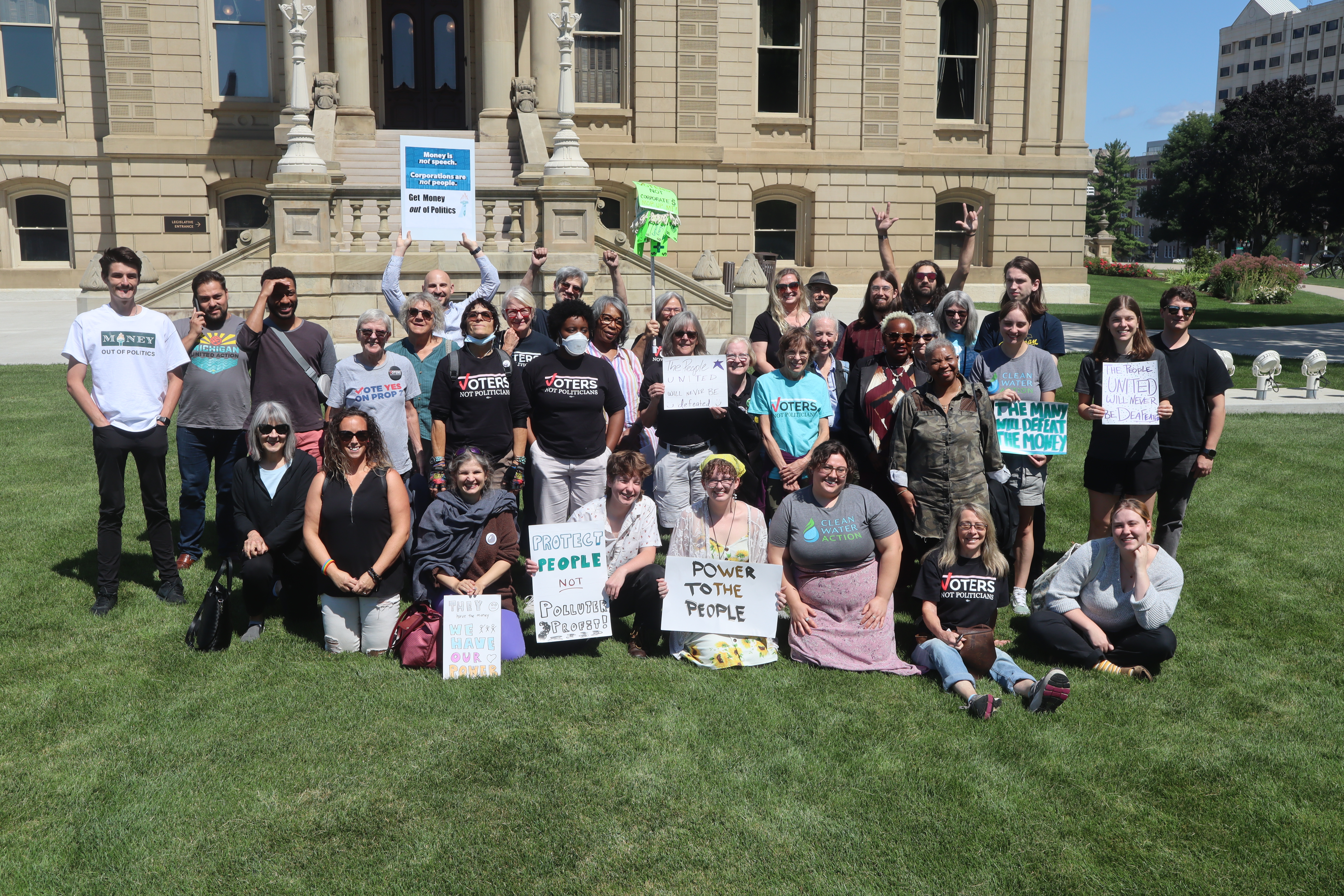
Michiganders for Money Out of Politics (MMOP) is a grassroots campaign working toward a statewide ballot initiative to ban political contributions from regulated monopoly corporations and major state contractors. The MMOP coalition includes Clean Water Action, Climate Cabinet, Detroit Action, Michigan League of Conservation Voters, Michigan United Action, MOSES Action, and Voters Not Politicians. Learn more at mopupmichigan.org.
About Clean Water Action
Clean Water Action is a national 501(c)(4) environmental organization with nearly one million members nationwide. Since our founding during the campaign to pass the landmark Clean Water Act in 1972, Clean Water Action has worked to win strong health and environmental protections by bringing issue expertise, solution-oriented thinking and people power to the table. Learn more at cleanwater.org.